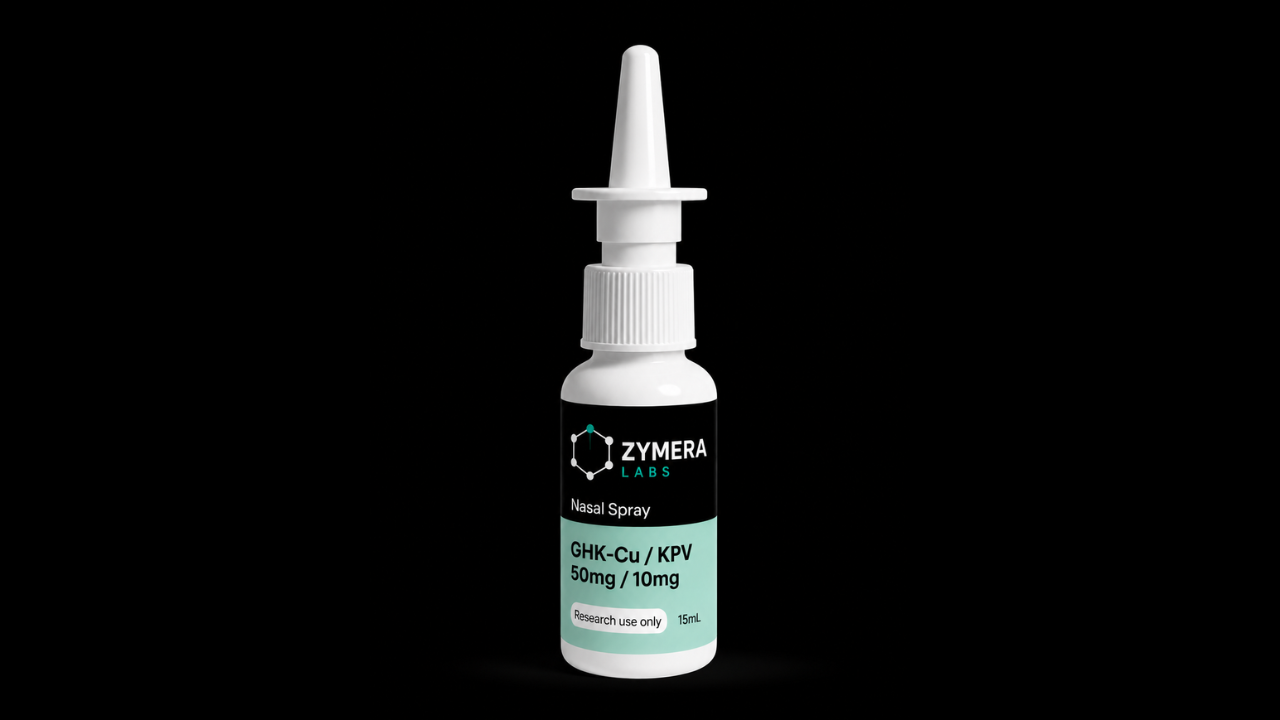

Nasal – GHK-Cu / KPV 50mg / 10mg
$259.00
GHK-Cu / KPV – DUAL RESEARCH PEPTIDE SYSTEM FOR TISSUE REPAIR, ANTI-INFLAMMATORY, AND REGENERATIVE SIGNALING STUDIES
Scientific Overview of GHK-Cu / KPV
This two-component peptide research formulation unites GHK-Cu (Copper Tripeptide-1)—a naturally occurring copper-binding tripeptide involved in wound healing and tissue remodeling—with KPV, a C-terminal α-MSH fragment known for its potent anti-inflammatory and cytoprotective activity. Together, they serve as a model system for studying cellular repair, immune modulation, and peptide-receptor cross-communication.
GHK-Cu (Copper Tripeptide-1)
Originally isolated from human plasma, GHK-Cu has become a cornerstone peptide in regenerative and tissue biology research. It functions as a metal–peptide signaling molecule that modulates gene expression related to tissue remodeling, oxidative stress defense, and fibroblast activity.
Research applications include:
• Wound Healing and Collagen Biosynthesis – induction of ECM gene expression and fibroblast proliferation (Pickart et al., 2015).
• Cellular Protection and Angiogenesis – studies of copper-mediated antioxidant enzyme activation and vascular regeneration.
• Stem Cell and Hair Follicle Research – exploration of GHK-Cu’s role in dermal and follicular signaling environments.
KPV (Lys–Pro–Val)
A minimal anti-inflammatory tripeptide fragment of α-melanocyte-stimulating hormone (α-MSH), KPV acts primarily through MC1R-mediated and NF-κB–inhibitory pathways.
Key research domains include:
• Inflammation Suppression Models – investigation of cytokine downregulation (IL-1β, TNF-α) in epithelial and immune cells.
• Barrier Integrity and Wound Recovery – study of peptide-driven epithelial restoration in intestinal and dermal systems (Getting et al., 2006).
• Melanocortin Receptor Pharmacology – mapping of truncated α-MSH analog effects on localized anti-inflammatory responses.
Combined Research Applications
When studied together, GHK-Cu and KPV provide a multi-mechanistic platform for exploring:
• Regenerative and anti-inflammatory synergy between copper-dependent growth modulation and melanocortin-mediated cytokine suppression.
• Cellular repair networks linking oxidative defense, collagen synthesis, and immune modulation.
• Tissue recovery and neuroprotective signaling through coordinated peptide–receptor and metal-ion interactions.
This combination serves as a comprehensive peptide pairing for research in tissue repair, anti-inflammatory regulation, and peptide–metal biology, offering a translational foundation for studies in regenerative peptide science.
Related products