
What Are Peptides? Types, Functions, Research Applications, Benefits, and Limitations Explained.

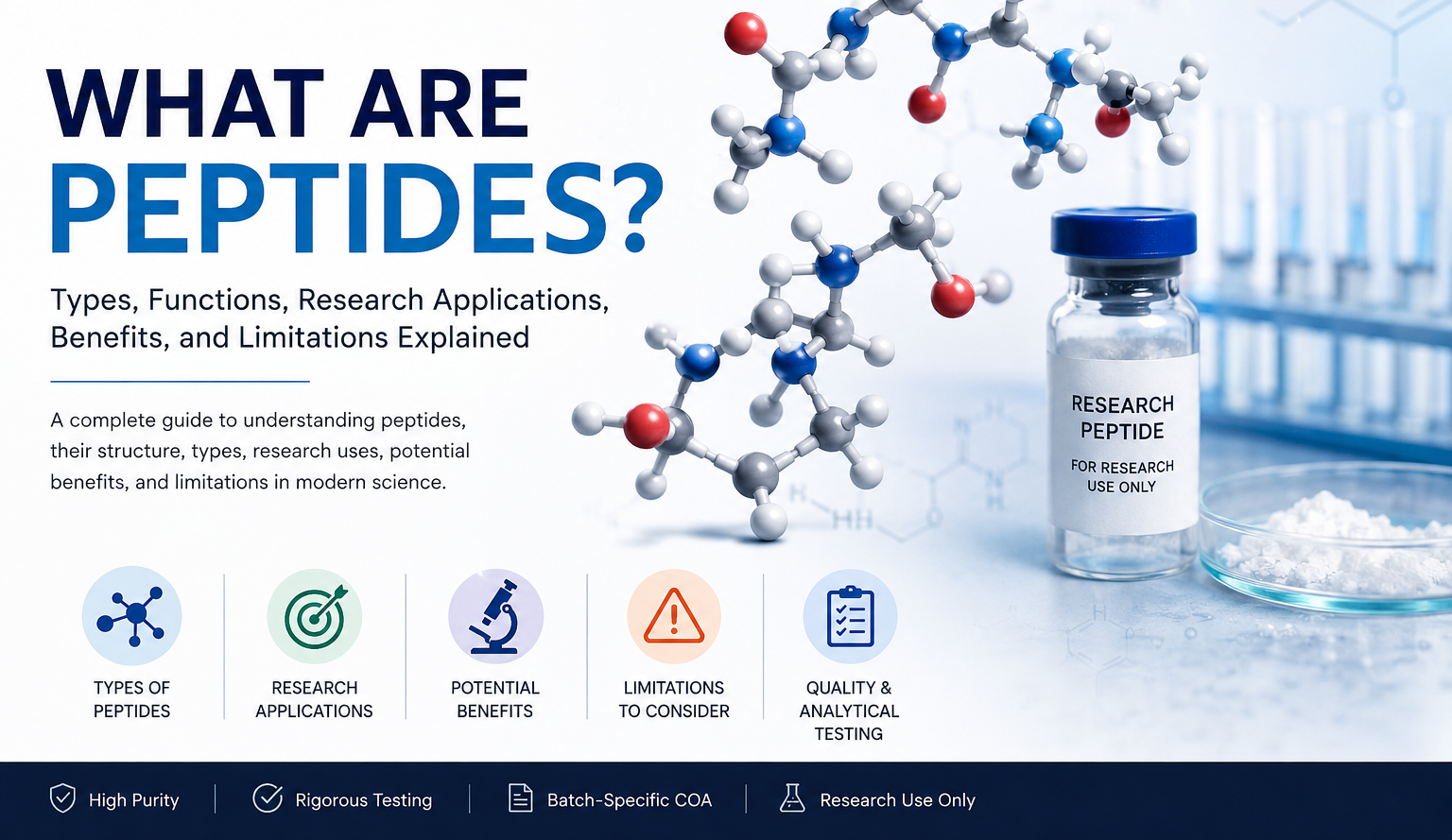
What Are Peptides? Types, Functions, Research Applications, Benefits, and Limitations Explained
Peptides have become one of the most studied molecular compounds in modern biological research. From drug discovery and biotechnology to analytical chemistry and laboratory experimentation, peptides play a central role in understanding cellular communication and protein function. Despite their growing importance, the term peptide is often misunderstood or confused with proteins.
This guide explains what peptides are, how they are formed, the different categories of peptides, their research applications, potential advantages, and the limitations researchers should understand when evaluating peptide-based studies.
What Are Peptides?
Peptides are short chains of amino acids connected by peptide bonds. Amino acids serve as the building blocks of proteins, and when a relatively small number of these molecules are linked together, they form a peptide.
Most peptides contain between two and fifty amino acids. Longer chains generally become classified as proteins because their structure and biological complexity increase significantly.
The amino acid sequence determines how a peptide behaves, what molecules it interacts with, and the biological processes in which it may participate.
How Peptides Work
Peptides function as signaling molecules throughout biological systems. They interact with specific receptors located on cells, allowing them to regulate numerous physiological processes.
Depending on their structure, peptides may influence:
- Cellular communication
- Hormone signaling
- Immune responses
- Enzyme regulation
- Tissue repair mechanisms
- Metabolic pathways
Because peptides are highly selective, researchers frequently study them to better understand complex biological functions.
Peptides vs Proteins
Although peptides and proteins are composed of amino acids, they differ primarily in size and structural complexity.
| Peptides | Proteins |
|---|---|
| Short amino acid chains | Long amino acid chains |
| Usually fewer than 50 amino acids | Usually more than 50 amino acids |
| Simpler three-dimensional structure | Complex folded structures |
| Often function as signaling molecules | Perform structural, enzymatic, and transport functions |
Proteins may contain one or more peptide chains folded into highly organized structures, whereas peptides generally remain much smaller and structurally simpler.
Major Types of Peptides
Different peptide classes perform different biological functions.
Signal Peptides
Signal peptides help direct newly synthesized proteins to specific locations within a cell. They function like biological “address labels” that guide proteins to their correct destination.
Hormonal Peptides
Some naturally occurring hormones are peptides that regulate communication between tissues and organs. Researchers study these molecules to better understand endocrine signaling pathways.
Antimicrobial Peptides
These peptides are part of the innate immune system and help organisms defend against bacteria, fungi, and certain viruses. They are an active area of biomedical research because of growing interest in antimicrobial resistance.
Carrier Peptides
Carrier peptides assist in transporting minerals or other molecules and are commonly investigated in cosmetic science and laboratory formulations.
Enzyme Inhibitory Peptides
Some peptides regulate biological activity by inhibiting specific enzymes, making them valuable tools for biochemical and pharmaceutical research.
How Peptides Are Produced
Most research peptides are manufactured using Solid-Phase Peptide Synthesis (SPPS), a technique that sequentially adds amino acids to a growing peptide chain attached to a solid resin.
After synthesis, purification methods such as High-Performance Liquid Chromatography (HPLC) help remove unwanted synthesis byproducts. The final product is typically verified using analytical methods including HPLC purity testing and mass spectrometry to confirm identity.
Common Research Applications of Peptides
Peptides are widely used across numerous scientific disciplines.
Examples include:
- Drug discovery research
- Cell signaling studies
- Protein interaction analysis
- Immunology research
- Molecular biology
- Biomarker discovery
- Analytical chemistry
- Biotechnology development
Researchers value peptides because they can selectively interact with biological targets while remaining relatively straightforward to synthesize compared with larger proteins.
Potential Benefits of Peptide Research
Within laboratory settings, peptides offer several practical advantages.
High Specificity
Many peptides interact with well-defined biological targets, making them valuable tools for studying cellular mechanisms.
Flexible Design
Researchers can modify peptide sequences to investigate how structural changes affect biological activity.
Efficient Laboratory Synthesis
Modern peptide synthesis techniques allow laboratories to produce highly customized peptide sequences with consistent quality.
Broad Scientific Applications
Peptides support research across pharmacology, molecular biology, immunology, oncology, neuroscience, and biotechnology.
Limitations of Peptides
Although peptides provide many research opportunities, they also present certain challenges.
Chemical Instability
Some peptide sequences are susceptible to degradation when exposed to moisture, heat, or repeated freeze-thaw cycles.
Storage Requirements
Many research peptides require controlled storage conditions to preserve stability over time.
Purity Matters
Experimental reliability depends heavily on peptide purity. Researchers commonly verify purity using HPLC and molecular identity using mass spectrometry before conducting experiments.
Sequence Sensitivity
Even a single amino acid difference may significantly alter a peptide’s biological properties.
How Researchers Evaluate Peptide Quality
When assessing research peptides, scientists typically review:
- HPLC purity reports
- Mass spectrometry identity confirmation
- Batch-specific Certificates of Analysis (COAs)
- Storage recommendations
- Manufacturing consistency
These quality control measures help ensure reproducibility and confidence in laboratory research.
Frequently Asked Questions
Are peptides the same as proteins?
No. Peptides are shorter amino acid chains, while proteins are generally much larger and possess more complex structures.
How are research peptides synthesized?
Most are produced using Solid-Phase Peptide Synthesis (SPPS), followed by purification and analytical quality testing.
Why is HPLC purity important?
HPLC measures the proportion of the target peptide relative to detectable impurities, providing an indication of sample quality.
What analytical methods verify peptide identity?
Mass spectrometry is commonly used alongside HPLC to confirm that the synthesized molecule matches the intended peptide sequence.
Conclusion
Peptides are fundamental biological molecules that continue to support advances across molecular biology, biotechnology, and pharmaceutical research. Their relatively simple structure, customizable sequences, and diverse biological functions make them valuable tools for scientific investigation.
Understanding peptide structure, synthesis methods, quality testing, and research applications enables scientists to evaluate peptide data more effectively and select materials that support reliable experimental outcomes.
3 thoughts on “What Are Peptides? Types, Functions, Research Applications, Benefits, and Limitations Explained.”